
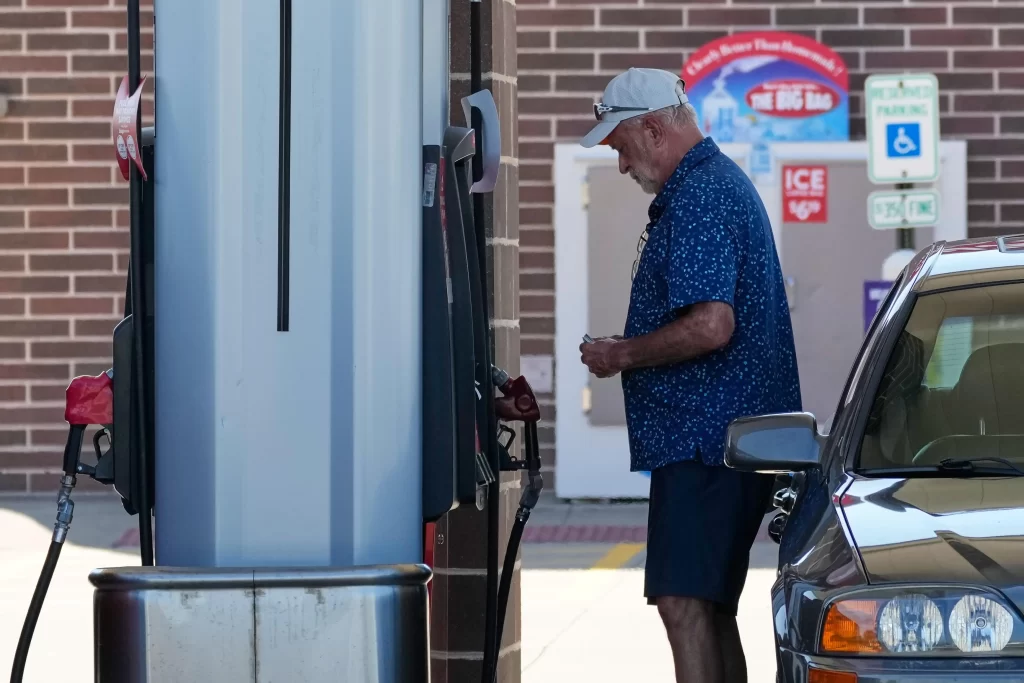
Being the owner of a gas station in the United States is, for the Latin American entrepreneur’s imagination, one of the most desired businesses in the American market. In a country where the automobile is basic infrastructure and vehicle traffic density is huge, the customer flow seems endless.
The numbers support that first impression. The U.S. gas station market with convenience stores reached $522.3 billion in 2025, according to PeerSense data updated in 2026. It is one of the country’s highest-sales sectors.
The problem is that sales volume is not the same as margin for the owner. And in 2026, the sector is undergoing a structural transformation driven by electric vehicles that will permanently change the rules of the business for anyone who has just entered.
This article explains what’s behind the big number, how much it really costs to get in, which business model makes the most sense for the Latin American investor applying for the E-2 visa, and what risks no sales brochure clearly explains to you.
The fact that changes everything: gasoline isn’t the business
This is the most counterintuitive insight in the sector and the one that most separates the informed investor from the one who learns the hard way.
The net profit margin from fuel sales is between 1.8% and 2%. In many states, after paying credit card fees, pump maintenance and regulatory compliance costs, gasoline leaves only pennies per gallon for the operator.
The real math: the average markup on a gallon of gasoline is between $0.35 and $0.40, and after expenses the operator retains roughly one third of that as pre-tax profit, according to Driivz’s analysis published in February 2026.
Relying exclusively on gasoline sales presents a persistent financial challenge for any operator who doesn’t understand where the real business is.
That real business is the Convenience Store (C-Store). Prepared foods, coffee, beverages and in-store products operate with crushing gross margins of between 30% and 40%. In practice, more than 70% of a modern gas station’s net profits come from what the customer buys inside, not from the fuel they pump outside.
Gasoline is the magnet that brings the customer to the door of your product.
The silent tsunami: how electric vehicles will erode 30% of margins by 2035
This is the sector’s most important structural risk in 2026 and the one you should understand before committing capital.
Electric vehicles could account for more than half of global passenger car sales by 2035. Growing EV demand has already displaced one million barrels of oil per day by 2026, directly impacting independent gas stations and convenience stores that rely on traditional fuel revenues. In markets where EVs dominate, total earnings for fuel and convenience store operators could fall 30% by 2035.
Does that mean the sector will disappear? No. It means it will transform. And those entering now with a “I sell gasoline” mindset instead of “I provide services to people on the move” have a structural problem in their business model.
The real opportunity that industry leaders are already capitalizing on is the concept of dwell time. A driver of a combustion vehicle spends 3 minutes at the pump and leaves. An electric vehicle user spends between 20 and 30 minutes waiting for their car to charge. That captive customer goes into the store, uses the Wi‑Fi, buys hot food and spends considerably more than someone who only filled up.
Major fuel and convenience chains, including 7‑Eleven, BP, Circle K and Shell, are leading the expansion of charging networks as part of a broader change in how they serve customers.
That investment in charging infrastructure is neither free nor optional: it is an adaptation cost the franchisee must include in their long‑term financial projection.
How much it really costs to open a gas station franchise in 2026
U.S. market ranges are the widest of any franchise category because they include both converting an existing station and building from scratch on owned land.
7‑Eleven: the “$0 franchise fee” trap
7‑Eleven is the world’s most recognized convenience store brand, with more than 30,000 locations globally. Its entry structure has a particularity that creates a lot of confusion.
The 7‑Eleven franchise cost in 2026 includes a $0 franchise fee and a total investment between $162,900 and $1,656,800. Buyers expecting the typical 6–8% royalty will find 7‑Eleven’s model surprising. It’s closer to an operating profit‑share partnership than a conventional franchise.
How does that model work in practice? The franchisor doesn’t charge a fixed percentage of gross sales. Instead, it takes between 45% and 56% of the business’s gross profit, not of sales. As a 7‑Eleven franchise owner, the operator receives approximately 48% of the annual profit margin on total sales. That translates to $339,000 for non‑fuel stores and $365,300 for stores with fuel.
Concretely: a store with $1.5 million in gross sales and a 30% gross margin generates $450,000 in gross profit. Of that, the franchisor takes between $202,500 and $252,000. The franchisee retains the remainder to cover their own operating expenses, including payroll, utilities and additional rents.
It’s a model that can generate attractive returns, but it is structurally different from what most investors expect when they look for a “franchise with a $0 upfront fee.”
AMPM (Backed by BP)
One of the strongest brands on the West Coast and in the southern U.S., with high traffic density and a strong quick‑service food offering.
- Total investment: between $431,000 and $11,000,000. The high end reflects purchasing premium real estate and building from scratch.
- Royalties: between 11% and 14% of gross sales, among the highest fees in the sector.
- Advantage: BP’s mass marketing guarantees immediate traffic from day one.
Circle K (The global giant)
One of the most structured brands for managing high‑volume stores, with very sophisticated point‑of‑sale and inventory systems.
- Total investment: between $279,000 and $5,300,000. The low end applies to brand conversions of existing stations.
- E‑2 advantage: its revenue management and audit technology is among the most complete on the market.
Street Corner / Express Convenience: just the store, no tank
If your capital is limited and you don’t want to assume the environmental liability of underground tanks, there’s an alternative model: invest exclusively in the convenience store without fuel, located inside a shopping center, airport or high‑density residential building.
Street Corner requires investments from $80,000 up to $2,000,000 depending on format and location. The risk profile is considerably lower than a full gas station: no tanks, no EPA compliance, no fuel supply management.
The three risks no sales brochure explains clearly
Risk 1: Environmental liability that can destroy your business
This is the number-one risk in the sector and the one new investors underestimate the most.
Any gas station with underground storage tanks (USTs) is regulated by the Environmental Protection Agency (EPA) under federal and state rules. A microleak in a tank can trigger federal audits, fines of hundreds of thousands of dollars, and the obligation to pay for soil remediation.
An environmental disaster not only bankrupts the business: it can consume all the investor’s capital in remediation costs and destroy the immigration status the business was meant to support.
Before committing capital to any gas station with underground tanks, you must audit that specific site’s environmental compliance history with an EPA-regulations specialist. It’s the difference between buying a clean asset and inheriting decades of environmental liabilities.
Risk 2: 24/7 operation with high staff turnover
Most gas stations in the U.S. operate 24 hours a day, 7 days a week. Managing three daily shifts of minimum-wage staff, with some of the highest turnover rates in the American labor market, is one of the most demanding operational challenges in the industry.
For the Latin American investor coming from abroad without prior experience managing teams in the U.S. market, that learning curve has a real cost during the first months. It’s not a model where the owner can comfortably supervise remotely: it requires active presence or a consolidated management team from day one.
Risk 3: Geopolitical volatility the owner can’t control
Fuel prices depend on the price of a barrel of oil, which in turn depends on OPEC decisions, geopolitical conflicts, and the energy policies of the current administration. A spike in oil prices can reduce traffic at the pumps and squeeze profitability in periods when fuel margins are already microscopic.
Why gas stations are one of the hardest businesses for the E-2 visa
The E-2 visa requires that the investor actively direct the business and that the business not be marginal. In that context, gas stations have two specific frictions that should be evaluated clearly.
First friction: the perception of a semi-passive investment. A gas station can operate with a shift manager while the owner is absent. The pump dispenses fuel automatically. The register records transactions without the owner’s intervention. That operational autonomy, which is an advantage as a business, can be interpreted by the consulate as evidence that the investor’s role is not genuinely managerial. The business plan must document precisely the executive role of the principal: strategic decisions, supplier management, expansion of the foodservice model, oversight of the management team.
Second friction: environmental liability as a risk to immigration status. A contamination incident that halts the business and generates debts with the EPA not only destroys capital but also the business that supported the visa. A business that no longer operates cannot remain the basis for an E-2 visa.
To understand which other business models create similar frictions in the consular process, our guide on businesses that do not qualify for the E-2 visa outlines the most frequent rejection patterns.
When a gas station does make sense for the Latin American investor profile
Not everything is ruled out. There are combinations of capital, experience, and market where a gas station can be a solid investment compatible with the E-2 visa process.
Available capital of $500,000 or more, with an operating cushion. The real investment range for major brands starts at that level for conversion formats of existing stations. Without additional working capital to absorb the first months, the financial stress can be unsustainable.
Prior experience managing high-volume retail or foodservice. The gas-station franchisee who reaches profitability fastest is the one who arrives with experience managing rotating staff and operating high-traffic stores, not the one who learns it from scratch.
Premium convenience-store model without fuel. For those who want the sector without the environmental risk of tanks, Street Corner or similar models in high-traffic locations (airports, shopping centers, corporate buildings) offer the same concept with lower regulatory complexity.
Deep understanding of the electric charging model. The operator who enters in 2026 with an integrated EV charging strategy from the start is positioning for the 2030 market, not just for today’s.
Alternatives with a better profile for the same capital
If available capital is between $300,000 and $800,000—the range where gas stations start to become accessible—there are alternatives in sectors without environmental risk, without 24/7 operations, and with significantly higher net margins.
Home-services franchises generate between 25% and 35% EBITDA with investments between $100,000 and $300,000. Specialized health franchises have AUVs between $1.8 and $2.5 million with staffs of 5 to 10 people. Commercial cleaning B2B models sign annual contracts with predictable revenue from month one.
None of those models carry EPA risk. None require 24/7 operation. And all have a consular-approval profile considerably cleaner than that of a gas station with underground tanks.
Our guide to the best franchises to buy in the U.S. in 2026 and the one on home-services franchises develop those alternatives with updated FDD data.
How we evaluate this at Interlink
At Interlink we analyze gas stations on a case-by-case basis. It’s not a sector we automatically discard, but it’s also not one we recommend as a first option for the investor who arrives without experience in high-volume retail, without capital significantly above the entry minimum, and without a clear plan for the EV-charging component.
Being the owner of a gas station in the United States is, for the Latin American entrepreneur’s imagination, one of the most desired businesses in the American market. In a country where the automobile is basic infrastructure and vehicle traffic density is enormous, customer flow seems endless.
The numbers back up that first impression. The gas station market with convenience stores in the U.S. reached $522.3 billion in 2025, according to PeerSense data updated in 2026. It’s one of the highest sales-volume sectors in the country.
The problem is that sales volume is not the same as margin for the owner. And in 2026, the sector is undergoing a structural transformation driven by electric vehicles that will permanently change the rules of the business for someone who has just entered.
This article explains what’s behind the big number, how much it really costs to enter, which business model makes the most sense for the Latin American investor applying for the E-2 visa, and which risks no sales brochure explains to you clearly.
The fact that changes everything: gasoline is not the business
This is the most counterintuitive insight in the sector and the one that most separates the informed investor from the one who learns the hard way.
The net profit margin on fuel sales is between 1.8% and 2%. In many states, after paying credit-card fees, dispenser maintenance and regulatory compliance costs, gasoline leaves only pennies per gallon for the operator.
The real math: the average markup on a gallon of gasoline is between $0.35 and $0.40, and after expenses the operator retains approximately one third of that as pre-tax profit, according to a Driivz analysis published in February 2026.
Relying exclusively on gasoline sales presents a persistent financial challenge for any operator who doesn’t understand where the real business is.
That real business is the Convenience Store (C-Store). Prepared foods, coffee, beverages and store merchandise operate with crushing gross margins of 30% to 40%. In practice, more than 70% of a modern gas station’s net profits come from what the customer buys inside, not the fuel they pump outside.
Fuel is the magnet that brings the customer to the door of your product.
The silent tsunami: how electric vehicles will destroy 30% of margins by 2035
This is the most important structural risk for the entire sector in 2026 and the one you should understand before committing capital.
Electric vehicles could represent more than half of global passenger car sales by 2035. Growing EV demand already displaced one million barrels of oil per day by 2026, directly impacting independent gas stations and convenience stores that rely on traditional fuel revenue. In markets where EVs dominate, total earnings for fuel and convenience-store operators could fall 30% by 2035.
Does that mean the sector will disappear? No. It means it will transform. And those entering now with a “I sell gasoline” mindset instead of “I provide services to people on the move” have a structural problem in their business model.
The real opportunity that industry leaders are already capitalizing on is the concept of dwell time. A combustion-engine driver spends 3 minutes at the pump and leaves. An electric-vehicle user spends 20–30 minutes waiting for their car to charge. That captive customer enters the store, uses the Wi‑Fi, buys hot food and spends considerably more than someone who only fueled up.
Major fuel and convenience chains, including 7‑Eleven, BP, Circle K and Shell, are leading the expansion of charging networks as part of a broader shift in how they serve customers.
That investment in charging infrastructure is neither free nor optional: it’s an adaptation cost the franchisee must incorporate into long‑term financial projections.
How much it really costs to open a gas‑station franchise in 2026
U.S. market ranges are the widest of any franchise category because they include both converting an existing station and building from scratch on owned land.
7‑Eleven: the “$0 franchise fee” trap
7‑Eleven is the world’s most recognized convenience‑store brand, with more than 30,000 locations globally. Its entry structure has a particularity that causes a lot of confusion.
The 7‑Eleven franchise cost in 2026 includes a $0 franchise fee and a total investment of between $162,900 and $1,656,800. Buyers expecting the typical 6–8% royalty will find 7‑Eleven’s model surprising. It’s closer to an operational profit‑sharing partnership than a conventional franchise.
How does that model work in practice? The franchisor does not charge a fixed percentage of gross sales. Instead, it takes between 45% and 56% of the business’s gross profit — not of sales, but of gross profit. As a 7‑Eleven franchise owner, the proprietor receives approximately 48% of the annual profit margin on total sales. That translates into $339,000 for non‑fuel stores and $365,300 for stores with fuel.
In concrete terms: a store with $1.5 million in gross sales and a 30% gross margin generates $450,000 in gross profit. Of that, the franchisor takes between $202,500 and $252,000. The franchisee retains the remainder to cover their own operating expenses, including payroll, utilities and additional rents.
It’s a model that can generate attractive returns, but it’s structurally different from what most investors expect when they look for a “franchise with a $0 initial fee.”
AMPM (Backed by BP)
One of the strongest brands on the U.S. West Coast and South, with high traffic density and a strong quick‑service food offering.
- Total investment: between $431,000 and $11,000,000. The upper end reflects purchase of premium real estate and ground‑up construction.
- Royalties: between 11% and 14% of gross sales, among the highest charges in the sector.
- Advantage: BP’s mass marketing guarantees immediate traffic from day one.
Circle K (The global giant)
One of the most structured brands for managing high‑volume stores, with very sophisticated POS and inventory systems.
- Total investment: between $279,000 and $5,300,000. The floor applies to banner conversions at existing stations.
- E‑2 advantage: its revenue management and audit technology is among the most comprehensive on the market.
Street Corner / Express Convenience: just the store, no tank
If your capital is limited and you don’t want to assume the environmental liability of underground storage tanks, there’s an alternative model: invest exclusively in the convenience store without fuel, inside a shopping center, airport or high‑density residential building.
Street Corner requires investments from $80,000 up to $2,000,000 depending on format and location. The risk profile is considerably lower than a full gas station: no tanks, no EPA compliance, no fuel‑supply management.
The three risks no sales brochure explains clearly
Risk 1: Environmental liability that can destroy your company
This is the sector’s number‑one risk and the one new investors most underestimate.
Every gas station with underground storage tanks (USTs) is regulated by the Environmental Protection Agency (EPA) under federal and state rules. A micro‑leak in a tank can trigger federal audits, fines of hundreds of thousands of dollars and the obligation to pay for soil remediation.
An environmental disaster not only bankrupts the business: it can consume all the investor’s capital in remediation costs and destroy the immigration status the business was meant to support.
Before committing capital to any gas station with underground tanks, you must audit that specific site’s environmental compliance history with an EPA‑regulations specialist. It’s the difference between acquiring a clean asset and inheriting decades of environmental liabilities.
Risk 2: 24/7 operation with high‑turnover staff
Most gas stations in the U.S. operate 24 hours a day, 7 days a week. Managing three daily shifts of minimum‑wage staff, with some of the highest turnover rates in the American labor market, is one of the market’s most demanding operational challenges.
For the Latin American investor who arrives from abroad without prior experience managing teams in the U.S. market, that learning curve has a real cost during the first months. This is not a model where the owner can comfortably supervise remotely: it demands active presence or a consolidated management team from the start.
Risk 3: Geopolitical volatility the owner cannot control
Fuel prices depend on the price per barrel of oil, which in turn depends on OPEC decisions, geopolitical conflicts, and the energy policies of the current administration. A spike in oil prices can reduce traffic at pumps and pressure profitability in periods when fuel margins were already microscopic.
Why gas stations are one of the most difficult businesses for the E-2 visa
The E-2 visa requires the investor to actively direct the business and that the business not be marginal. In that context, gas stations have two specific frictions that should be clearly evaluated.
First friction: the perception of a semi-passive investment. A gas station can operate with a shift manager while the owner is not present. The pump dispenses fuel automatically. The register records transactions without the owner’s intervention. That operational autonomy, which is an advantage as a business, can be interpreted by the consulate as evidence that the investor’s role is not genuinely managerial. The business plan must document precisely the executive role of the principal: strategic decisions, supplier management, expansion of the foodservice model, supervision of the management team.
Second friction: environmental liability as a risk to immigration status. A contamination incident that halts the business and generates debts with the EPA not only destroys capital but also the business that supported the visa. A business that no longer operates cannot continue to be the basis for an E-2 visa.
To understand what other business models generate similar frictions in the consular process, our guide on businesses that do not qualify for the E-2 visa develops the most frequent rejection patterns.
When a gas station does make sense for the Latin American investor profile
Not everything is ruled out. There are combinations of capital, experience and market where a gas station can be a solid investment and compatible with the E-2 visa process.
Available capital of $500,000 or more, with an operating cushion. The real investment range for major brands starts at that level for conversion formats of existing stations. Without additional working capital to absorb the first months, the financial stress can be unsustainable.
Prior experience managing high-volume retail or foodservice. The gas station franchisee who reaches profitability fastest is the one who comes with experience managing rotating staff and operating high-traffic stores, not the one who learns it from scratch.
Premium convenience-store model without fuel. For those who want the sector without the environmental risk of tanks, Street Corner or similar models in high-traffic locations (airports, malls, corporate buildings) offer the same concept with lower regulatory complexity.
Deep understanding of the electric vehicle charging model. The operator who enters in 2026 with an integrated EV charging strategy from the start is positioning themselves for the 2030 market, not just today’s.
Alternatives with a better profile for the same capital
If the available capital is between $300,000 and $800,000—the range where gas stations start to be accessible—there are alternatives in sectors without environmental risk, without 24/7 operation, and with significantly higher net margins.
Home-service franchises generate between 25% and 35% EBITDA with investments between $100,000 and $300,000. Specialized health franchises have AUVs between $1.8 and $2.5 million with staff of 5 to 10 people. Commercial B2B cleaning models sign annual contracts with predictable revenue from month one.
None of those models carry EPA risk. None require 24/7 operation. And all have a consular approval profile considerably cleaner than that of a gas station with underground tanks.
Our guide to the best franchises to buy in the U.S. in 2026 and the one on home-service franchises develop those alternatives with updated FDD data.
How we evaluate this at Interlink
At Interlink we analyze gas stations on a case-by-case basis. It’s not a sector we automatically discard, but it’s also not one we recommend as a first option for the investor who arrives without experience in high-volume retail, without capital significantly above the minimum entry level, and without a clear plan for the EV charging component.
If you have sufficient capital, retail experience and understand the sector’s transformation, it can be a very solid opportunity. If your capital is in the $150,000 to $400,000 range, owning a gas station in the United States is, in the imagination of the Latin American entrepreneur, one of the most desired businesses in the American market. In a country where the automobile is basic infrastructure and vehicle traffic density is enormous, customer flow seems endless.
The numbers back up that first impression. The U.S. gas station market with convenience stores reached $522.3 billion in 2025, according to PeerSense data updated in 2026. It is one of the country’s highest-sales-volume sectors.
The problem is that sales volume is not the same as margin for the owner. And in 2026, the sector is undergoing a structural transformation driven by electric vehicles that will permanently change the rules of the business for someone who has just entered.
This article explains what’s behind the big number, how much it really costs to enter, which business model makes the most sense for the Latin American investor applying for the E-2 visa, and what the risks are that no sales brochure explains clearly.
The fact that changes everything: gasoline is not the business
This is the most counterintuitive insight in the sector and the one that most separates the informed investor from the one who learns the hard way.
The net profit margin on fuel sales is between 1.8% and 2%. In many states, after paying credit-card fees, pump maintenance and regulatory compliance costs, gasoline leaves only cents per gallon for the operator.
The real math: the average markup on a gallon of gasoline is between $0.35 and $0.40, and after expenses the operator retains approximately one-third of that in pre-tax profit, according to Driivz’s analysis published in February 2026.
Continuing to depend exclusively on gasoline sales presents a permanent financial challenge for any operator who does not understand where the real business is.
The real business is the Convenience Store (C-Store). Prepared foods, coffee, beverages and store items operate with crushing gross margins of between 30% and 40%. In practice, more than 70% of a modern gas station’s net profits come from what the customer buys inside, not from the fuel they pump outside.
Gasoline is the magnet that brings the customer to the door of your product.
The silent tsunami: how electric vehicles will destroy 30% of margins by 2035
This is the most important structural risk across the entire sector in 2026 and the one you should understand before committing capital.
Electric vehicles could account for more than half of global passenger car sales by 2035. Growing EV demand had already displaced one million barrels of oil per day by 2026, directly impacting independent gas stations and convenience stores that rely on traditional fuel revenue. In markets where EVs dominate, total profits for fuel operators and convenience stores could fall by 30% by 2035.
Does that mean the sector will disappear? No. It means it will transform. And those entering now with a “I sell gasoline” mindset instead of “I provide services to people who are on the move” have a structural problem in their business model.
The real opportunity that sector leaders are already capitalizing on is the concept of dwell time. A driver of an internal-combustion car spends 3 minutes at the pump and leaves. An electric vehicle user spends 20–30 minutes waiting for their car to charge. That captive customer goes into the store, uses the Wi‑Fi, buys hot food and spends significantly more than someone who only filled up with gas.
Major fuel and convenience chains, including 7‑Eleven, BP, Circle K and Shell, are leading the rollout of electric charging networks as part of a broader shift in how they serve customers.
That investment in charging infrastructure is neither free nor optional: it’s an adaptation cost that the franchisee must incorporate into their long‑term financial projections.
How much it really costs to open a gas station franchise in 2026
U.S. market ranges are the widest of any franchise category because they include both converting an existing station and building from scratch on owned land.
7‑Eleven: the “$0 franchise fee” trap
7‑Eleven is the world’s most recognized convenience‑store brand, with over 30,000 locations globally. Its entry structure has a particularity that causes a lot of confusion.
The 7‑Eleven franchise cost in 2026 includes a $0 franchise fee and a total investment between $162,900 and $1,656,800. Buyers expecting the typical 6–8% royalty will find 7‑Eleven’s model surprising. It is closer to an operating partnership with profit sharing than a conventional franchise.
How does that model work in practice? The franchisor does not charge a fixed percentage of gross sales. Instead, it takes between 45% and 56% of the business’s gross profit—not of sales, but of gross profit. As a 7‑Eleven franchise owner, the operator receives roughly 48% of the annual gross profit margin on total sales. That translates to $339,000 for non‑fuel stores and $365,300 for stores with fuel.
In concrete terms: a store with $1.5 million in gross sales and a 30% gross margin generates $450,000 in gross profit. Of that, the franchisor takes between $202,500 and $252,000. The franchisee retains the remainder to cover all operating expenses, including payroll, utilities and additional rents.
It’s a model that can generate attractive returns, but it is structurally different from what most investors expect when they look for a “franchise with a $0 initial fee.”
AMPm (Backed by BP)
One of the strongest brands on the U.S. West Coast and South, with high traffic density and a strong fast‑food offering.
- Total investment: between $431,000 and $11,000,000. The high end reflects premium real estate purchases and ground‑up construction.
- Royalties: between 11% and 14% of gross sales, among the highest charges in the sector.
- Advantage: BP’s mass marketing guarantees immediate traffic from day one.
Circle K (The global giant)
One of the most structured brands for managing high‑volume stores, with very sophisticated POS and inventory systems.
- Total investment: between $279,000 and $5,300,000. The low end applies to brand conversions in existing stations.
- E‑2 advantage: their management and revenue‑audit technology is among the most complete in the market.
Street Corner / Express Convenience: just the store, not the tank
If your capital is limited and you don’t want to take on the environmental liability of underground tanks, there is an alternative model: invest exclusively in the convenience store without fuel, located in a shopping center, airport or high‑density residential building.
Street Corner requires investments from $80,000 up to $2,000,000 depending on format and location. The risk profile is significantly lower than a full gas station: no tanks, no EPA compliance, no fuel‑supply management.
The three risks no sales brochure explains clearly
Risk 1: Environmental liability that can destroy your company
This is the sector’s number‑one risk and the one most new investors underestimate.
Any gas station with underground storage tanks (USTs) is regulated by the Environmental Protection Agency (EPA) under federal and state rules. A micro‑leak in a tank can trigger federal audits, fines of hundreds of thousands of dollars and the obligation to pay for soil remediation.
An environmental disaster not only bankrupts the business: it can consume all the investor’s capital in remediation costs and destroy the immigration status the business was intended to support.
Before committing capital to any gas station with underground tanks, audit that specific site’s environmental compliance history with an EPA‑regulations specialist. It’s the difference between acquiring a clean asset and inheriting decades of environmental liabilities.
Risk 2: 24/7 operations with high‑turnover staff
Most gas stations in the U.S. operate 24 hours a day, 7 days a week. Managing three daily shifts of minimum‑wage staff, with some of the highest turnover rates in the U.S. labor market, is one of the most demanding operational challenges in the industry.
For a Latin American investor arriving from abroad without prior experience managing teams in the U.S. market, that learning curve has a real cost during the first months. This is not a model where the owner can comfortably supervise remotely: it requires active presence or a consolidated management team from day one.
Risk 3: Geopolitical volatility the owner can’t control
Fuel prices depend on the price of a barrel of oil, which in turn depends on OPEC decisions, geopolitical conflicts and the energy policies of the current administration. A spike in oil prices can reduce pump traffic and squeeze profitability during periods when fuel margins are already microscopic.
Why gas stations are one of the hardest businesses for the E‑2 visa
The E‑2 visa requires the investor to actively direct the business and that the enterprise not be marginal. In that context, gas stations have two specific frictions you should evaluate clearly.
First friction: the perception of a semi-passive investment. A gas station can operate with a shift manager while the owner is not present. The pump dispenses fuel automatically. The register records transactions without the owner’s intervention. That operational autonomy, which is an advantage as a business, can be interpreted by the consulate as evidence that the investor’s role is not genuinely managerial. The business plan must accurately document the holder’s executive role: strategic decisions, supplier management, expansion of the foodservice model, oversight of the management team.
Second friction: environmental liability as a risk to immigration status. A contamination incident that paralyzes the business and creates debts with the EPA not only destroys the capital but also the business that supported the visa. A business that no longer operates cannot continue to be the basis for an E-2 visa.
To understand which other business models generate similar frictions in the consular process, our guide on businesses that do not qualify for the E-2 visa outlines the most frequent rejection patterns.
When a gas station does make sense for the Latin American investor profile
Not everything is ruled out. There are combinations of capital, experience, and market where a gas station can be a solid investment compatible with the E-2 visa process.
Available capital of $500,000 or more, with an operating cushion. The real investment range for major brands starts at that level for conversion formats of existing stations. Without additional working capital to absorb the first months, financial stress can become unsustainable.
Prior experience managing high-volume retail or foodservice. The gas station franchisee who reaches profitability fastest is the one who arrives with experience managing rotating staff and operating high-traffic stores, not the one who learns it from scratch.
Premium convenience store model without fuel. For those who want exposure to the sector without the environmental risk of tanks, Street Corner or similar models in high-traffic locations (airports, malls, corporate campuses) offer the same concept with lower regulatory complexity.
Deep understanding of the electric charging model. The operator who enters in 2026 with an integrated EV charging strategy from the start is positioning for the 2030 market, not just for today’s.
Alternatives with a better profile for the same capital
If the available capital is between $300,000 and $800,000—the range where gas stations become accessible—there are alternatives in sectors without environmental risk, without 24/7 operations, and with significantly higher net margins.
Home-service franchises generate between 25% and 35% EBITDA with investments between $100,000 and $300,000. Specialized health franchises have AUVs between $1.8 and $2.5 million with staff of 5 to 10 people. Commercial B2B cleaning models sign annual contracts with predictable revenues from month one.
None of those models carry EPA risk. None require 24/7 operation. And all have a consular approval profile considerably cleaner than that of a gas station with underground tanks.
Our guide to the best franchises to buy in the U.S. in 2026 and the one on home-service franchises develop those alternatives with updated FDD data.
How we evaluate this at Interlink
At Interlink we analyze gas stations on a case-by-case basis. It’s not a sector we automatically rule out, but it’s also not one we recommend as a first option for an investor who arrives without high-volume retail experience, without capital significantly above the minimum entry level, and without a clear plan for the EV charging component.
Schedule your free consultation here and we’ll evaluate it together with concrete data.
Leave a Reply