
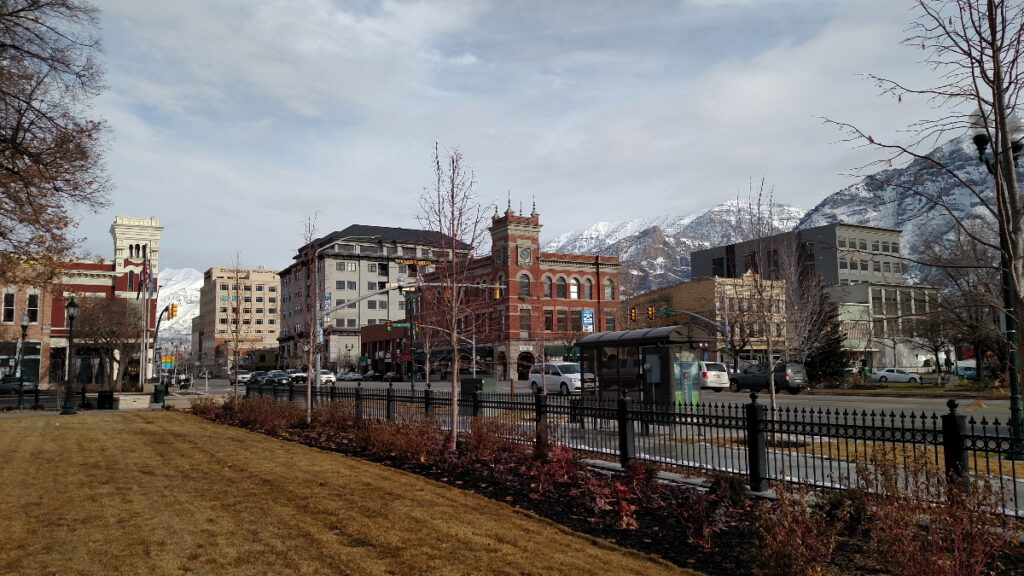
When a Latin American investor starts researching which state to locate their franchise with an E-2 investor visa, the first names are always the same: Texas, Florida, California. And there are good arguments for each of them.
But there is one state that institutional investors, private equity funds and large tech firms have quietly been choosing for years, and that
Utah surpassed 3.5 million inhabitants in 2026 and its tech corridor, known as Silicon Slopes, brings together more than 7,500 companies that employ over 175,000 workers and contribute roughly $25 billion to the state’s GDP, according to analysis published by Ask Doss in March 2026. Adobe, Microsoft, Google, Goldman Sachs, Qualtrics, Domo and Podium have offices or headquarters here.
The state’s economy showed remarkable strength and continued to grow in 2025, navigating a complex national landscape, according to the Economic Report presented to the Governor by the Kem C. Gardner Institute in January 2026. And the outlook for 2026 projects moderate expansion built on the same foundations that drove it: a strong labor market, a diversified economy and consistent population growth.
What makes Utah particularly interesting for the Latin American investor is not just that growth. It comes with less competition than saturated markets, and there are specific sectors with demand growing faster than supply.
The most surprising labor-market stat: Provo has 0.1 candidates per high-wage job
This number summarizes better than any chart the opportunity that exists in Utah for someone who arrives with a well-structured business.
In Provo, the demographic heart of the Silicon Slopes, there are only 0.1 daily candidates per high-wage job available — a fraction of the national average, according to data from the state entrepreneurship portal published in 2026. Utah overall leads the national market with 22.6 daily candidates per well-paid job, compared with the second state (Missouri) with 19.2.
For the owner of a service franchise who needs to hire technicians, specialists or quality staff in the first quarter of operation, that stat means something very concrete: competition for hiring is lower, and starting wages can be more stable than in markets like California or New York where exhaustion of available talent pressures payroll costs from day one.
The economic engine: what makes Utah special in 2026
Silicon Slopes: the Silicon Valley nobody mentions
The Silicon Slopes is the tech corridor that stretches along Interstate 15 from Lehi to Draper, with satellite presence in Salt Lake City and Provo.
The 7,500 tech companies that employ more than 175,000 workers in Utah contribute approximately $25 billion to the state’s GDP. Companies like Qualtrics (sold to Silver Lake for $12.5 billion in 2023), Pluralsight, Domo, Podium and MX Technologies are headquartered here, while Adobe, Microsoft, Google and Goldman Sachs operate large regional offices.
That ecosystem doesn’t just generate tech jobs. It creates tens of thousands of young, high-income families that need services, education, healthcare and home maintenance — exactly the sectors with the best margins for franchisees in 2026.
The youngest demographics in the U.S.: guaranteed demand for family services
Utah has the youngest population in the country. Draper, for example, has approximately 30% of its population under 18, and 65% of its residents are married, reflecting an ideal community for young families.
That translates into sustained demand for daycares, sports academies, educational services, wellness centers and home maintenance. These are exactly the sectors with the best net margins and the strongest consular approval profile for the E-2 visa.
Internal migration flow from California and Colorado
Utah’s growth is driven by two simultaneous engines: a high local birth rate and migration from more expensive states like California, Washington and Colorado, according to the Salt Lake City labor-market analysis published in March 2026. Every family arriving from California generates demand for local services (painting, remodeling, childcare, fitness) that the local market still lacks the capacity to fully cover.
Rapid growth creates pressure: median home prices in Salt Lake County nearly doubled since 2018. That’s complicated for someone who wants to buy a house, but it’s exactly the opportunity for someone who arrives to provide remodeling, maintenance and property management services.
The 4 cities with the best profile for the Latin American investor in 2026
Lehi: the epicenter of the Silicon Slopes
Located between Salt Lake City and Provo, Lehi is the fastest-growing city in the tech corridor. It’s where young, high-income families working in software and fintech are concentrated.
The best-fit business profile: premium home services (specialized cleaning, landscaping, technical maintenance), STEM-focused childcare and specialized health services for active adults. These are sectors with demand that exceeds available supply and a client base that pays for quality, not looking for the lowest price.
Salt Lake City: the corporate and logistics engine
The capital has the region’s busiest international airport and the highest density of office buildings. It’s the ideal market for B2B models: commercial cleaning, IT support for SMBs, logistics, professional services.
Corporate contracts in Salt Lake City have higher average ticket sizes than equivalent markets in Texas or Florida, because the concentration of tech-budgeted companies is above the national average.
Provo and Orem: the area with the highest per-capita demand for family services
Driven by Brigham Young University (BYU) and a high rate of families with children, this metropolitan area has the highest per-capita demand for family-oriented services in all of Utah. Boutique fitness, sports academies, extracurricular education, preventive health and mental wellness have waitlists in several markets in this area.
The monthly membership model fits perfectly with the local demographics: stable families with predictable incomes who prioritize their children’s wellbeing and are willing to pay for quality services on a regular basis.
St. George: the destination for high-net-worth Californian retirees
Located in the southern part of the state, near the Nevada border and two hours from Las Vegas, St. George has one of the fastest growth rates in the country driven by retirees from California and other coastal states seeking warmer climate and lower cost of living.
That demographic profile generates specific demand: in-home elder care, ancillary medical services, home remodeling and adaptation, and property management for those who own second homes in the area.
The 3 sectors with the best net margin for the E-2 visa in Utah in 2026
1. Home services and remodeling: demand the market can’t meet
Utah’s massive population growth has created a residential services market that exceeds the current installed capacity of providers. Exterior painting, fence installation, specialized cleaning, technical maintenance and kitchen and bathroom remodeling have lead times of weeks in several Silicon Slopes markets.
Franchises in this sector such as The Brothers That Just Do Gutters, Go Painting, Archadeck or ServiceMaster Clean have territories available in the Lehi-Draper corridor with a client base growing faster than the supply of operators.
Our complete guide on home services franchises in the U.S. develops the models with the best net margins available in 2026.
2. B2B services for the tech ecosystem: recurring contracts with growing companies
With 7,500 active tech companies and dozens of new startups opening each month in the Silicon Slopes, there is a structural demand for corporate services that goes beyond what the local market can absorb.
Franchises offering IT support for small businesses (like Nerds To Go), commercial office cleaning, testing labs (Fastest Labs for the logistics and transportation sector that supports tech) and business logistics services have annual contracts available in a market where competition has not yet reached the levels seen in Texas or California.
The B2B model has an additional advantage for the E-2 visa process: annual contracts signed with corporate clients are objective evidence of predictable future cash flow, which the consulate needs to see in the business plan.
3. Boutique health, wellness and fitness: the most active population in the country
Utah has the highest participation rate in outdoor and fitness activities in the entire U.S. Immediate access to five national parks, top-tier skiing and world-class hiking creates a culture of active well-being that translates into an extraordinary demand for preventive health services, physical therapy, boutique fitness and muscle recovery.
Franchises like Fyzical Therapy, Stretch Zone, BODYBAR Pilates or Game Day Men’s Health have ideal demographics in the suburbs of the Silicon Slopes. The monthly membership model works especially well in this region because the customer base has stable incomes, values quality over price and shows high renewal rates.
However, keep in mind the caveat we developed in our note about Pilates and Stretch franchises: the largest conglomerate in the sector (Xponential Fitness) shows warning signs in 2026. Brands outside that ecosystem have a better entry profile.
Why Utah is different from Texas and Florida for the Latin American investor
The most important difference to understand before comparing markets is this: Utah does not have the Hispanic community of Texas or Florida. The proportion of Hispanic population in the state is significantly lower than in San Antonio, Miami or Houston.
That has two concrete implications.
The first is operational: an investor who arrives in Utah faces a steeper cultural integration curve than in markets with a Hispanic majority. There is no neighborhood where everyone speaks Spanish, and there are no consolidated Latino communities in most cities across the Silicon Slopes.
The second is a business opportunity: precisely because the Hispanic community is small, the market for services specifically aimed at Latino consumers (tax preparation in Spanish, insurance in Spanish, bilingual professional services) has very little competition. Those who arrive with that focus can capture that niche with a real competitive advantage.
If you prioritize settling in a city with an established Latino community, our guide on why San Antonio is the most chosen city by Latin American investors offers the most relevant direct comparison.
How much capital you need for the Utah market
For a mid–high income market like the Silicon Slopes, the investment range we recommend at Interlink for the profile of the Latin American investor applying for the E-2 visa is between $150,000 and $300,000.
That range allows access to home services franchises, boutique fitness or B2B franchises with proven models and transparent FDDs, in territories where demand exceeds available supply and the average customer ticket is higher than in more affordable markets.
To understand how to calculate the working capital needed beyond the initial investment, our guide on how much capital you need to survive the first year with an E-2 visa develops this with concrete data.
And if your available capital is below that range, our guide to affordable and profitable franchises under $150,000 has accessible options with a good track record of consular approval that can also apply to markets like Provo or St. George where operating costs are lower than in Salt Lake City.
The warning you should know: passive real estate doesn’t work for the E-2 visa
Utah’s real estate boom is real: prices in Salt Lake County have nearly doubled since 2018. Many Latin American investors see that and consider buying properties to rent out.
The problem is the same as in any other state: buying houses to rent them out passively does not qualify for the E-2 visa. The consulate classifies it as a passive investment without active economic impact. To understand that distinction with official data, our guide on whether buying a house in the U.S. grants residency dismantles it clearly.
The alternative that does work: a property management franchise structured as an active business, with W-2 employees, management contracts with third‑party owners and a documented executive role for the investor.
How we evaluate this at Interlink
Utah is not the most familiar market among Latin American investors, and that is exactly what makes it interesting for those who discover it before others. Available territories are not yet as saturated as markets in Texas or Florida, and the Silicon Slopes’ young, high‑income demographics generate demand for services that the local market cannot fully satisfy.
At Interlink we evaluate opportunities in Utah on a case‑by‑case basis, matching the investor’s profile with the fastest‑growing sectors and the territories that best fit each type of franchise.
If you want us to evaluate whether Utah makes sense for your capital and migration goal, the first consultation is free. Schedule here and we’ll work on it together.
Leave a Reply